Land Planning
Entitlements, layouts, agency coordination, public hearings — the political and procedural side of getting a project approved. Bailey runs the entitlement process from the first comp plan read to the final council vote.
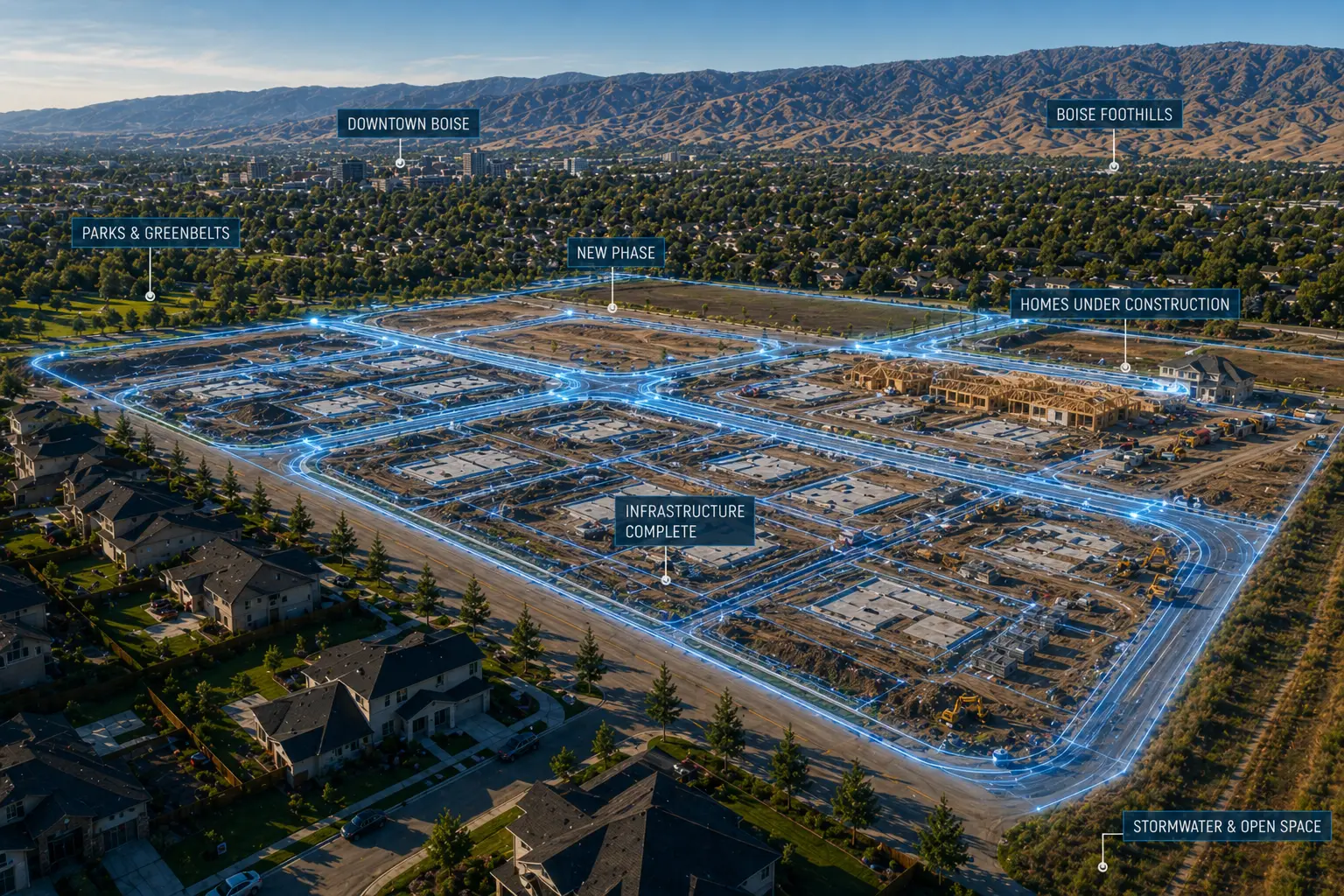
What we deliver.
Land planning is the discipline that decides whether the engineering gets to happen at all. Before a single line of civil design is drawn, the parcel has to be entitled — zoned, platted, approved by the city, supported (or at least not opposed) by the neighbors, and signed off by every agency with jurisdiction. Bailey handles the full entitlement path across every Treasure Valley city.
Entitlements
The full regulatory path from concept to council vote — annexation, rezone, comp plan amendments, conditional use, preliminary and final plat.
Read more → 02Preliminary Layout
The conceptual land plan that locks in 80% of your yield, infrastructure cost, and project economics before engineering begins.
Read more → 03Agency Coordination
ACHD, ITD, irrigation districts, fire, health, school districts — every agency that has to sign off, in the right order.
Read more → 04Code & Comprehensive Plan Research
Zoning analysis, comp plan alignment, FLUM review, and the research that tells you whether the project fits before you file.
Read more → 05Overall Project Management
One point of contact carrying the project from feasibility through final plat — schedule, budget, agency coordination, and builder partner management.
Read more → 06Neighborhood Meetings
The single highest-leverage hour before a public hearing — surface opposition early, when there's still time to address it.
Read more → 07Public Hearings
Preparation, presentation, and the strategy that turns a contested vote into an approved one.
Read more →The gate that every project has to clear.
Land planning runs Phase 3 in Bailey's 9-phase process — from concept and pre-application through preliminary plat and public hearings — and it's the gate. Get it wrong and the engineering fees get spent twice — once on the design that didn't get approved, and once on the redesign that does. Get it right and the engineering moves forward on solid ground, with the political support, the agency sign-offs, and the community engagement already done.
Bailey starts every entitlement engagement the same way: by reading the city. We pull the comprehensive plan, the future land use map, the zoning code, and the most recent planning commission and council minutes. We look at what the city has been approving, what it's been denying, and where the political temperature sits on the kind of project our client wants to build. That context — not the code alone, but the code in the hands of the people interpreting it — is what separates a smooth entitlement from a contested one.
The preliminary layout is the next critical step. This is the conceptual land plan that determines how many lots, units, or square feet the parcel can support. It happens before formal engineering and usually before the entitlement filing. The decisions made here lock in 80% of the project's economics — lot yield, infrastructure cost, and marketability — so we treat it with the rigor it deserves, even though it doesn't feel like "real engineering" to most clients.
Agency coordination runs through the entire process. A typical Treasure Valley project requires sign-off from six to ten external agencies beyond the city itself — ACHD, the relevant irrigation district, the fire district, the health department, the school district, and often ITD or the county. Each one has independent authority to condition or stop the project, and the order in which they're engaged matters. Bailey maps the full agency list at feasibility and engages them before the first formal submittal, not after.
Neighborhood meetings and public hearings are where the political work comes to a point. Bailey runs neighborhood meetings as a core part of every entitlement — not as a checkbox, but as the single highest-leverage hour before the public hearing. We handle notification, materials, presentation, and follow-up. At the hearing itself, the work is confirming, not convincing — because the confirming work happened in the neighborhood meeting and the staff report.
The output of land planning is an approved project: entitled, platted, conditions of approval documented, agency sign-offs secured, development agreement executed (where required), and the final plat routed through the health department, highway district, county surveyor, city, and recorder. Bailey carries the project through every step.
Where it fits in the 9-phase process.
Site Identification & Feasibility
Feasibility — zoning, comp plan alignment, political context, constraint mapping.
Entitlements (including Preliminary Plat)
Planning and entitlement strategy — concept plans, pre-application meetings, agency feedback, and neighborhood context.
Entitlements (including Preliminary Plat)
Entitlements — application prep, neighborhood meetings, P&Z and council hearings.
Final Plat Routing & Recording
Final plat routing and recording — agency sign-offs, mylars, recorder.
See the full 9-phase process →
Bailey's construction-phase role is professional engineering support: observation reports, agency inspection coordination, record drawings, and punch-list support. Contractors, builders, and developers perform construction and vertical development.